
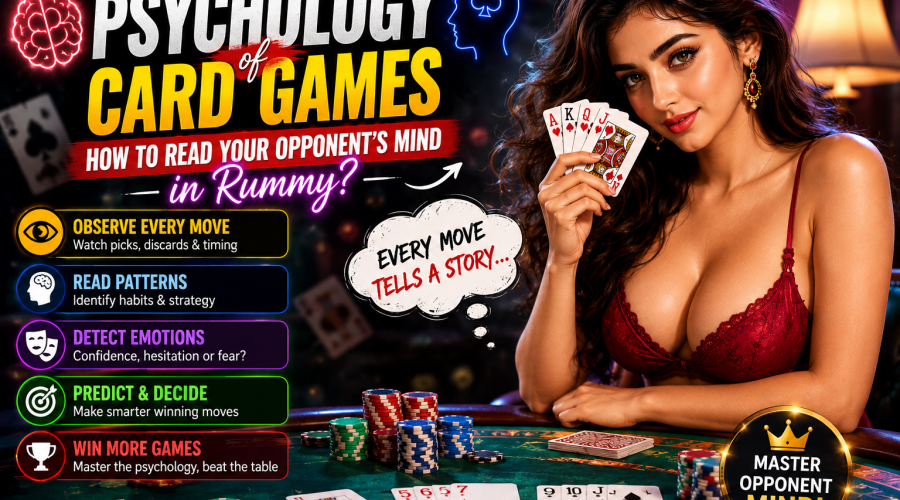
🧠 Psychology of Card Games: How to Read Your Opponent’s Mind in Rummy?
The Psychology of Card Games is one of the most fascinating and overlooked aspects of online rummy. Most beginners believe that winning depends only on cards, luck, or game knowledge. However, experienced players know that understanding human behavior can provide a massive competitive advantage.
In modern online rummy, players are not simply competing against cards. They are competing against real people who make decisions based on emotions, habits, pressure, confidence, fear, and strategy. Understanding these psychological patterns helps players predict moves, avoid traps, and make smarter decisions.
Many successful rummy players spend years developing observation skills. They learn how opponents react under pressure, how they manage risky situations, and how their card-picking behavior reveals hidden information.
This is where the Psychology of Card Games becomes extremely valuable.
A player who understands psychology can often gain information that is not immediately visible on the table. Small actions, repeated patterns, and decision timing can reveal valuable clues about an opponent’s strategy.
🎯 Why Psychology Matters More Than Luck in Long-Term Rummy Success
Many new players focus entirely on cards and combinations. While card management is important, long-term success often comes from understanding people rather than cards.
Professional players know that cards change every game, but human behavior often remains predictable.
For example:
- Nervous players become predictable under pressure.
- Overconfident players take unnecessary risks.
- Defensive players avoid aggressive decisions.
- Emotional players often chase losses.
- Patient players wait for high-probability opportunities.
By recognizing these tendencies, players can make more informed decisions and avoid costly mistakes.
This is one of the strongest benefits of studying the Psychology of Card Games.
🎭 Understanding Mind Games in Online Rummy
Every rummy game contains a hidden psychological battle.
Players constantly try to:
- Hide valuable information
- Mislead opponents
- Create uncertainty
- Protect strong combinations
- Reduce predictability
Experienced players understand that every discard sends a message.
Sometimes that message is genuine.
Sometimes it is intentionally misleading.
Strong players carefully analyze these signals before making important decisions.
The Psychology of Card Games teaches players how to separate real information from deceptive information.
👀 Observation Skills: The Secret Weapon of Winning Players
Observation is perhaps the most valuable psychological skill in rummy.
Most beginners focus only on their own cards.
Professional players constantly monitor:
- Opponent picks
- Discard patterns
- Reaction speed
- Repeated behaviors
- Risk tolerance
- Sequence-building habits
Every observed action provides additional information.
The more information collected, the better future decisions become.
This creates a major competitive advantage over players who ignore observation completely.
📈 How to Identify Opponent Patterns
Human beings naturally develop habits.
Most rummy players unknowingly repeat similar behaviors throughout a session.
Common patterns include:
- Always keeping face cards too long.
- Frequently chasing difficult sequences.
- Discarding low cards aggressively.
- Avoiding risky combinations.
- Playing too defensively.
Once patterns become visible, predicting future actions becomes easier.
For example:
If an opponent repeatedly picks cards from a specific suit, there is a strong possibility they are building a sequence involving that suit.
Recognizing such patterns allows players to adjust strategy accordingly.
🃏 Reading Discard Behavior Like a Professional
Discard behavior reveals more information than most players realize.
Strong players carefully study:
- What cards are discarded
- When cards are discarded
- How frequently face cards appear
- Whether connected cards are discarded
- Whether risky cards are retained
A player discarding multiple connected cards may have shifted toward a completely different strategy.
A player holding face cards for a long time may still be chasing incomplete combinations.
These clues become extremely useful when making important decisions.
🔥 Emotional Decision Making: The Biggest Weakness in Rummy
Emotions often destroy good strategy.
Many players make poor decisions because they become emotionally attached to specific cards or combinations.
Common emotional mistakes include:
- Holding face cards too long
- Ignoring obvious risks
- Chasing unlikely sequences
- Playing aggressively after losses
- Making rushed decisions
Experienced players remain calm regardless of short-term results.
This emotional discipline helps them maintain consistency across multiple games.
Understanding emotional behavior is a major component of the Psychology of Card Games.
⏱️ What Decision Timing Can Reveal
Decision speed often reveals valuable information.
Players who instantly discard a card usually have a clear plan.
Players who hesitate may be:
- Considering multiple options
- Facing difficult choices
- Protecting important combinations
- Unsure about strategy
Although timing alone should never be treated as absolute proof, it often provides useful supporting information.
Professional players combine timing analysis with observation and card tracking to improve accuracy.
🧩 Why Consistent Observation Beats Guesswork
Many beginners rely on intuition.
Professional players rely on evidence.
Instead of guessing, they collect information throughout the game and build logical conclusions.
This process includes:
- Tracking discards
- Monitoring picks
- Studying timing
- Analyzing risk behavior
- Identifying repeated patterns
Consistent observation reduces uncertainty and improves strategic decision-making significantly.
🧠 How Professional Rummy Players Predict Opponent Moves
One of the most powerful Psychology of Card Games techniques is prediction. Professional rummy players do not simply react to the game. Instead, they constantly predict what their opponents might do next.
Every action at the table creates valuable information. The cards an opponent picks, the cards they discard, and even the speed of their decisions can reveal hidden patterns.
Experienced players often ask themselves:
- Which sequence is my opponent trying to complete?
- Why did they pick that card?
- Why did they discard this card?
- Are they playing aggressively or defensively?
- Are they close to declaring?
These questions help players build a mental picture of the opponent’s hand.
The more accurately you predict opponent behavior, the better your decisions become.
🎭 Understanding Bluffing in Rummy
Many players associate bluffing only with Teen Patti or Poker. However, bluffing can also appear in online rummy.
Although rummy is primarily a skill-based game, players can still use psychological tactics to confuse opponents.
Common examples include:
- Discarding misleading cards
- Hiding sequence intentions
- Creating false signals
- Changing gameplay patterns
- Controlling visible information
For example, a player may intentionally discard a card that appears useless while secretly building a different sequence.
This creates uncertainty and makes opponents misread the hand.
⚡ The Psychology of Fast vs Slow Players
Decision speed often reveals valuable information.
Fast Players
- Usually confident
- Already have clear plans
- Often close to completing combinations
- May be experienced players
Slow Players
- Still analyzing options
- May have weak hands
- Often uncertain about decisions
- Sometimes trying to mislead opponents
While decision speed is not always accurate, it can provide useful clues when combined with card observations.
👀 Reading Opponent Confidence Levels
Confidence is one of the easiest psychological signals to identify.
Confident players typically:
- Pick cards quickly
- Discard without hesitation
- Maintain consistent gameplay
- Appear relaxed throughout the game
Less confident players often:
- Take longer to decide
- Change strategies frequently
- Hold risky cards too long
- Make emotional decisions
Learning to recognize confidence levels helps you understand when opponents may be approaching a declaration.
🎯 Why Observation Beats Guessing
Many beginners try to guess opponent hands randomly.
Professional players rely on evidence.
They observe:
- Discard history
- Picked cards
- Card patterns
- Sequence possibilities
- Gameplay consistency
Observation-based decisions are far more reliable than emotional guesses.
This is one reason experienced players consistently outperform beginners over the long term.
📈 Developing Your Own Psychological Strategy
Psychology is not only about reading opponents. It is also about controlling how opponents read you.
Strong players often:
- Avoid predictable patterns
- Mix their decisions occasionally
- Remain emotionally neutral
- Hide valuable information
- Maintain consistent gameplay behavior
The less information you reveal, the harder it becomes for opponents to predict your strategy.
🔥 Advanced Mind-Reading Techniques Used by Experts
Professional players often use advanced observation systems.
They track:
- Repeated card preferences
- Suit preferences
- Discard timing
- Reaction patterns
- Risk-taking tendencies
Over multiple rounds, these observations create accurate opponent profiles.
This helps players adapt their strategies more effectively.
🧠 Psychology of Card Games – रम्मी में विरोधी के दिमाग को कैसे समझें?
रम्मी केवल कार्ड्स का खेल नहीं है। यह दिमाग, रणनीति और मनोविज्ञान का खेल भी है।
सफल खिलाड़ी केवल अपने कार्ड्स पर ध्यान नहीं देते बल्कि विरोधी खिलाड़ियों की सोच को भी समझने की कोशिश करते हैं।
इसी कारण Psychology of Card Games आज आधुनिक रम्मी रणनीति का महत्वपूर्ण हिस्सा बन चुकी है।
🎯 विरोधी के व्यवहार को समझना क्यों जरूरी है?
हर खिलाड़ी कुछ संकेत छोड़ता है।
- कौन सा कार्ड उठाता है
- कौन सा कार्ड छोड़ता है
- कितनी तेजी से निर्णय लेता है
- किस प्रकार का जोखिम लेता है
- कितना आक्रामक खेलता है
ये सभी संकेत उसकी संभावित रणनीति को समझने में मदद करते हैं।
👀 Observation Skill कैसे विकसित करें?
Observation Skill किसी भी रम्मी खिलाड़ी की सबसे महत्वपूर्ण मानसिक क्षमता होती है।
बेहतर Observation के लिए:
- Discard Pile पर लगातार नजर रखें
- Opponent Picks को याद रखें
- Repeated Patterns पहचानें
- भावनात्मक अनुमान लगाने से बचें
- तथ्यों के आधार पर निर्णय लें
समय के साथ यह Skill काफी मजबूत हो जाती है।
⚡ Bluffing और Psychological Pressure
हालांकि रम्मी में Bluffing की भूमिका Teen Patti जितनी बड़ी नहीं होती, फिर भी कुछ खिलाड़ी मानसिक दबाव बनाने की कोशिश करते हैं।
- भ्रामक कार्ड डिस्कार्ड करना
- अपनी वास्तविक योजना छिपाना
- गलत संकेत देना
- खेल की गति बदलना
अनुभवी खिलाड़ी ऐसे संकेतों को पहचानना सीख जाते हैं।
🏆 सफल खिलाड़ी क्या अलग करते हैं?
सफल खिलाड़ी:
- Emotion Control रखते हैं
- Observation Skill विकसित करते हैं
- Risk Management अपनाते हैं
- Opponent Psychology समझते हैं
- लंबी अवधि की रणनीति अपनाते हैं
यही कारण है कि वे लगातार बेहतर प्रदर्शन कर पाते हैं।
🌍 Psychology and Modern Online Rummy in 2026
2026 में ऑनलाइन रम्मी पहले से अधिक प्रतिस्पर्धी हो चुकी है।
अब केवल अच्छे कार्ड्स मिलना पर्याप्त नहीं है।
खिलाड़ियों को आवश्यकता होती है:
- Strategic Thinking
- Psychological Awareness
- Opponent Reading Skills
- Decision Making Ability
- Emotional Discipline
यही गुण सफल खिलाड़ियों को भीड़ से अलग बनाते हैं।
❓ Additional FAQs
Q6. Can psychology improve my rummy performance?
Yes. Understanding opponent behavior can significantly improve decision-making quality.
Q7. Is bluffing useful in rummy?
While less important than in Teen Patti, subtle bluffing can sometimes create confusion for opponents.
Q8. What is the biggest psychological mistake players make?
Making emotional decisions after losses or difficult situations.
Q9. How can I improve observation skills?
Focus on discarded cards, picked cards, gameplay patterns, and opponent tendencies.
Q10. Do professional players use psychology regularly?
Absolutely. Psychology and observation are major components of advanced rummy strategy.
🔗 Related Guides
- Best Rummy Apps India
- How to Win Online Rummy
- Pure Sequence Guide
- Rummy Bankroll Management Tips
- Rummy Tournament Tips
- Why Discard High Value Cards Early?
🌐 Useful Resources
🏁 Final Conclusion
The Psychology of Card Games plays a crucial role in modern online rummy. While cards and strategy remain important, understanding human behavior can provide a major competitive advantage.
Professional players continuously observe opponents, identify patterns, recognize emotional reactions, and use psychological information to make smarter decisions.
If you want to improve your online rummy performance in 2026, focus not only on your cards but also on the minds of your opponents. Strong observation, emotional discipline, and psychological awareness can often become the difference between an average player and a consistent winner.
Master the Psychology of Card Games, learn to read your opponent’s mind, and elevate your rummy strategy to the next level.